contents: 0-1. CA Intro
MIPS ISA
What is MIPS ISA
- Microprocessor without Interlocked Pipelined Stages
- A kind of ISA
Design principles
- Simplicity favors regularity
- Smaller is faster
- Make the common case fast
Design Principle 1
Simplicity favors regularity
- Regularity: all MIPS arithmetic instructions include a single operation & three operands
- Regularity makes implementation simpler
- Simplicity enables higher performance at lower cost
Examples
- add a, b, c
- sub a, a, d
Design Principle 2
Smaller is faster
- Operands of MIPS arithmetic instructions must be chosen in a small number of registers
- Register: Fast locations for data
- 32 32-bit registers in MIPS
- 32 is that can be represented by using 5 bits
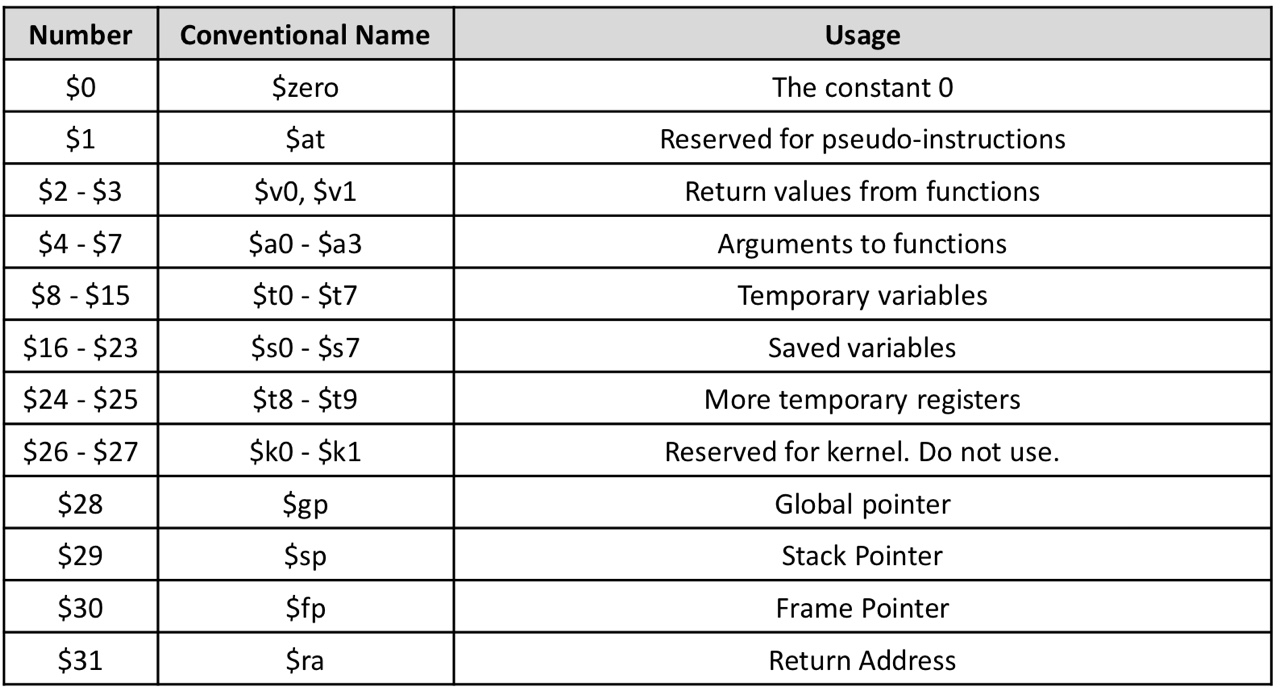
Practice 1
C code:
f = (g + h) - (i + j)Compiled MIPS assembly language code:
add $t0, $s1, $s2
add $t1, $s3, $s4
sub $s0, $t0, $t1
Memory instruction
Memory organization
keep a small amount data in registers and other remaining, complex data in memory
- Load values from memory into registers
- Store results from registers to memory
Address
A memory address is an index to the memory array, starting at 0 MIPS uses byte addressing (Each address identifies an 8-bit byte)
But, most data items are larger than a byte. So, they use "words"
- In MIPS, a ward is 32 bits
- Registers also hold 32-bit of data
Alignment restrictions
- The start address of each data should be multiple of N, where N is the size of the data
- In MIPS, words must start at a addresses that are multiples of 4
- Some data items use one or two bytes (halfword)
Byte ordering
- Big endian(MIPS): place the most significant byte first and the least significant byte last
- Little endian: place the least significant byte first and the most significant byte last
Load/Store
- lw reg1 offset(reg2): Load 32-bit word from the memory address reg2 + offset into reg1
- sw reg1 offset(reg2): Store 32-bit word in reg1 at the memory address reg2 + offset
- lh/sh and lb/sb instructions load/store halfwords and 8-bit of data
Practice 2
C code:
g = h + A[8]- A is an array of 4-bytes words
- The value of g and h are in
$s1and$s2 - The base address of A is in
$s3
Compiled MIPS assembly language code:
lw $t0, 32($s3)
add $s1, $s2, $t0
Practice 2
C code:
A[12] = h+ A[8]- A is an array of 4-bytes words
- The value of h is in
$s2 - The base address of A is in
$s3
Compiled MIPS assembly language code:
lw $t0, 32($s3)
add $t0, $s2, $t0
sw $t0, 48($s3)
Practice 3
C code:
f = (g + h) - (i + j)- f, g, and h are in
$s0,$s1, and$2respectively - Halfwords i and j are sequentially stored in memory
- The start address of i is stored in
$s3
Compiled MIPS assembly language code:
add $t0, $s1, $s2
lh $t1, 0($s3)
lh $t2, 2($s3)
add $t3, $t1, $t2
sub $s2, $t0, $t3
Design Principle 3
Make the common case fast
Common case : a program uses a small constant in an operation many times
Solution: support
-
16-bit immediate operands for handling the constants
- no need to access memory to load the constants
addi $t0, $t0, 4: addi is an add immediate instruction
-
MIPS register 0 (
$zero) contains the constant 0add $t0, $t1, $zero: move values between two registers$t0andt1
Practice 4
C code:
f = A[10] - i + 4Ais an array of bytes and its base address is stored in$s0fandiare stored in$s1and$s2respectively
Compiled MIPS assembly language code:
lb $t0, 10($s0)
sub $t1, $t0, $s2
addi $s1, $t1, 4
Summary: MIPS ISA
Key underlying design principles
- Design principle 1. Simplicity favors regularity
- All MIPS arithmetic instructions include a single operation & three operands
- Design principle 2. Smaller is faster
- Operands of MIPS arithmetic instructions must be chosen in a small number of registers
- MIPS keeps more complex data in memory and supports data transfer between memory and registers
- Design principle 3. Make the common case faster
- Support 16-bit immediate operands for handling small constants +
$zero
- Support 16-bit immediate operands for handling small constants +